English
 Nederlands
 Français
 Deutsch
 Italiano
 Русский
 Español



 Facebook
 Youtube
 Twitter
 Instagram
 Pinterest
 LinkedIn
MUSTANG! Just those two syllables conjure up not simply a vision of the quintessential American muscle-car but an understanding of America itself.
Car Tales: Americana Personified, Ford Mustang Coupe
When I lived in Australia, my Greek aunt had a 1967 Ford Mustang coupe 2-door hardtop. Even better she had a pink 1967 Ford Mustang coupe 2-door hardtop.
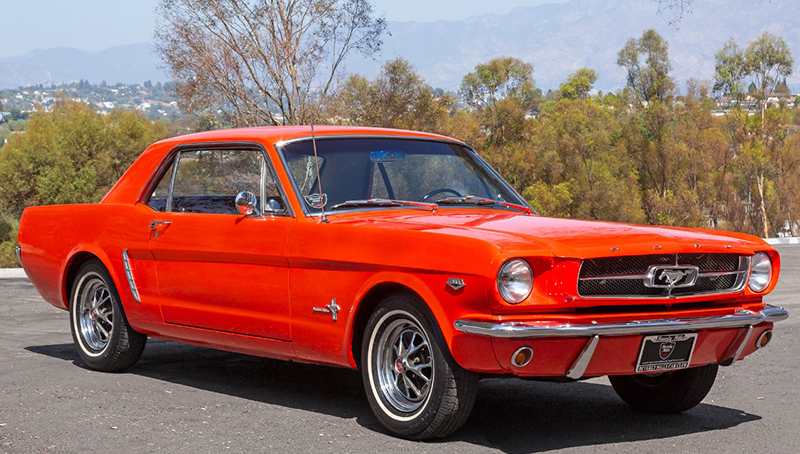
MUSTANG! Just those two syllables conjure up not simply a vision of the quintessential American muscle-car but an understanding of America itself. When I lived in Australia, my Greek aunt had a 1967 Ford Mustang coupe 2-door hardtop. Even better she had a pink 1967 Ford Mustang coupe 2-door hardtop.
That pink ’67 Ford Mustang coupe really clicked with me and probably was what got me into my present occupation. When my aunt would drive it around town in Australia, it got the kind of attention a pink Lamborghini would get in Beverly Hills. I really loved that car.
To me the Ford Mustang defined a spirit of American freedom. Whoever dreamt up what that car should be called when it first arrived in dealerships in 1964 absolutely hit the bullseye. You immediately conjured up visions of wild horses roaming the American interior, free and untamed – a perfect image for a pretty perfect car.
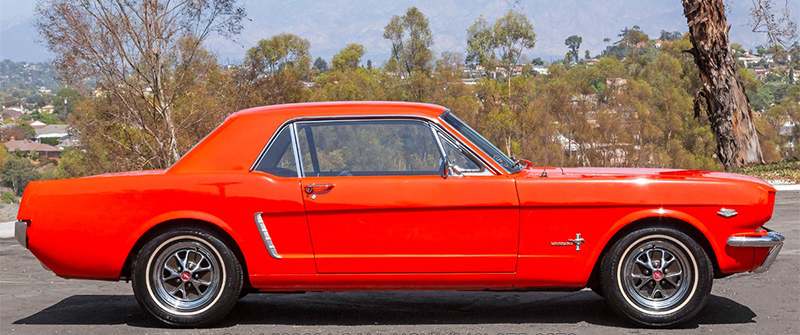
The Ford Mustang was initially introduced on April 17, 1964, as a hardtop and convertible with the fastback version put on sale in August 1964. It was an immediate hit, and the Mustang we have right now at Beverly Hills Car Club is part of that first edition.
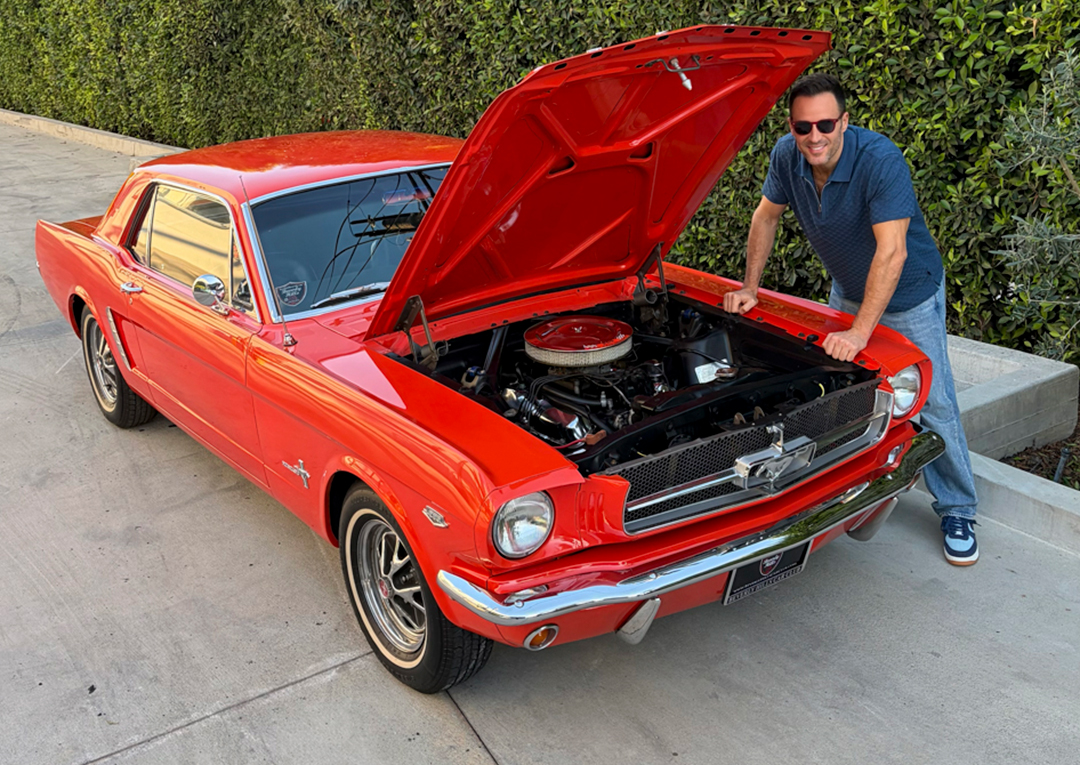
A standout from Ford’s early Mustang lineup, this 1965 Ford Mustang Coupe ‘K-Code’ High Performance 289 4-Speed, is finished in its factory Poppy Red (3) exterior color over a Black interior. As an early example from the Mustang’s first full model year, this car combines the classic styling of the original Mustang with the desirable K-Code High Performance 289 V8 and a 4-speed manual transmission. The combination of its factory color combination, performance-oriented equipment, and unmistakable early Mustang styling makes it an appealing example of Ford’s original pony car formula.
Power comes from a 289ci High Performance V8 paired with a 4-speed manual transmission. The K-Code engine was Ford’s high-performance version of the 289, rated at 271 horsepower when new. This Mustang is also equipped with a 4-barrel carburetor, front-wheel disc brakes with Wilwood calipers, and 14-inch styled steel wheels wrapped in Cooper Trendsetter thin whitewall tires. The exterior retains the familiar early Mustang appearance with chrome trim and bumpers, ‘Mustang’ script emblems, running horse badges, and ‘High Performance 289’ fender emblems.
Inside, the cabin features front bucket seats, a rear bench seat, lap belts, a three-spoke steering wheel, and the early-style horizontal 120-mph speedometer cluster. A steering-column-mounted Rally-Pac adds a tachometer and clock, while dual-side rearview mirrors and a push-button radio complete the interior equipment. Additional equipment includes a jack and spare tire in the trunk.
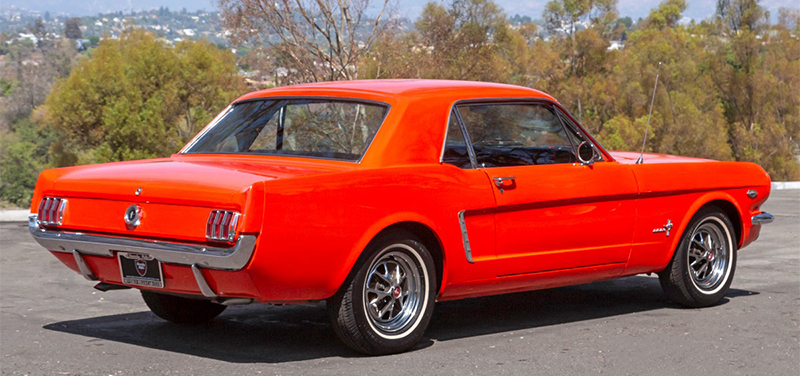
When Ford introduced the Mustang in April 1964, it quickly attracted attention for its combination of sporty styling, compact dimensions, and accessible pricing. More than 22,000 orders were placed on the first day, helping establish the Mustang as a major success for Ford. The 1965 model continued that momentum while offering the K-Code High Performance 289 for buyers looking for additional performance from the Mustang’s V8 lineup.
With its Poppy Red exterior, 4-speed manual transmission, K-Code 289 V8, and period-correct styling details, this Mustang offers a great opportunity to own an early example of one of Ford’s most recognizable performance cars. This highly desirable Ford Mustang Coupe K-Code is mechanically sound.
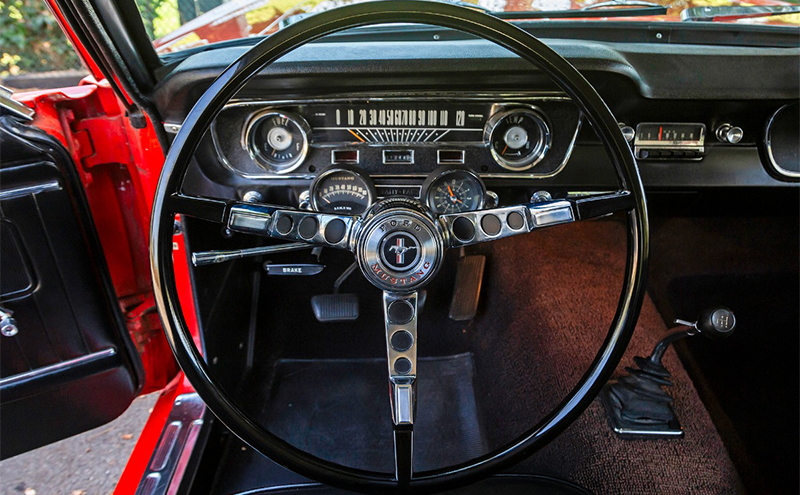
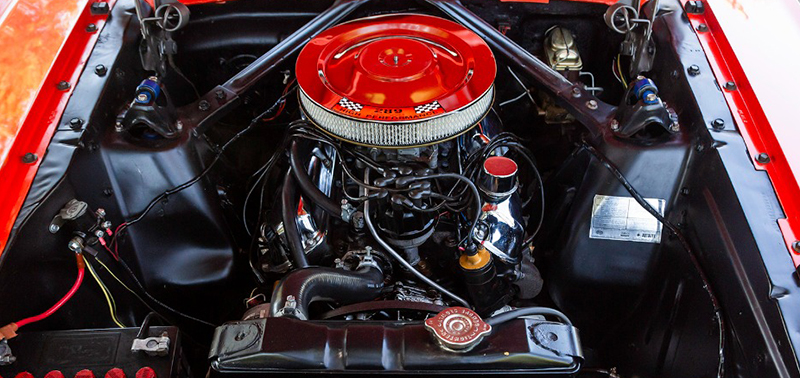
But what exactly is a K-Code 289? In the early days of the ‘Stang, the K-code was the only performance option – unless you spent a couple-thousand extra for a Shelby GT 350 — which sported a modified 289 HiPo engine. The K-code engine was rated at 271 horsepower, 6,000 rpm with 312 lb-ft peak torque at 3,400 rpm. It was available from 1964 to 1967, and some 13,000 K-code Mustangs were built. This accounted for less than one percent of the 1.8 million Mustangs produced in that time span.
The K-code engine is easily identified from the other 289 engines when peering under the hood. It features a 2-inch-wide damper, compared to a 1-inch-wide damper found on standard 289s. The K-code engine also has a centrifugal-advanced dual-point distributor, whereas standard 289 engines had a vacuum-advanced single-point distributor.
Perhaps the most iconic difference is heard and not seen; the solid-lifter camshaft that boasted specs of .460-inch total valve lift with 1.6:1 rockers and 310-degrees advertised duration. Ford also equipped the HiPo cylinder heads with threaded rocker studs and provided a slightly larger Autolite 480-cfm, 4-barrel carburetor with the K-code option. The Ford Mustang was initially introduced on April 17 1964, as a hardtop and convertible; its styling borrowed from the sleek lines of European sports-cars. The hardtop cost an affordable $2,368.
The press conference for this April 17 1964 announcement was at the New York World’s Fair and aimed way beyond the motoring media.
Ford knew what they had and were after the greatest response they could get. Accordingly, the company did something no-one had done before: Ford bought key primetime advertising slots – Perry Mason on CBS; The Jimmy Dean Show on ABC; and on NBC’s Hazel – on all three networks, showing ads that highlighted the Mustang’s looks and cost.
This mass-market blitz paid off. The idea was to create ‘Mustang Mania’ – it was the same year as Beatle-mania, of course – and it worked. There were near riots in Pittsburgh, Arkansas, and Texas as people clamoured to showrooms to see the new car.
Marketed at youthful baby-boomers, with an emphasis on women drivers (42 per cent were sold to women), the Mustang was an immediate hit with the buying public. 22,000 orders were placed on day one. Within four months 100,000 had been sold.
By March 1966 one million Ford Mustangs were on the roads.
-Alex Manos, Owner


Get Started!
Welcome!
join our inventory newsletter
Sign-up for our e-mail alerts
join our newsletter
Sign-up for our e-mail alerts
Learn More
or
we buy classic cars
Looking to sell yours?
Contact us
Sell us your car
Pick up from any USA location - Any condition - Top $$$ Paid


Chat With Us!