


 English
 Nederlands
 Français
 Deutsch
 Italiano
 Русский
 Español



 Facebook
 Youtube
 Twitter
 Instagram
 Pinterest
 LinkedIn
By the time we got to Woodstock
We were half a million strong
And everywhere there was song and celebration
– Joni Mitchell

Car Tales: Freak Out, Volkswagen Type 2 Deluxe Bus
Stuck in a Manhattan hotel waiting for her ride, Joni Mitchell never made it to the Woodstock Music & Art Fair for her scheduled spot on August 18 1969.
With its lugubriously onomatopoeic place-name of Huddersfield, the Yorkshire milltown would seem the living definition of that old northern English adage that ‘Where there’s muck there’s brass’ – in other words, that in the grimmest conditions may be found plenty of opportunities for profit.
Instead, she wrote the musical anthem of the landmark counter-cultural festival.
Rather than be let down by seemingly countless broken promises of airborne transportation, Joni Mitchell might have fared rather better by traveling the back roads of New York State in one of what for a time was known as the archetypal ‘hippie bus’.
The Volkswagen Type 2 Deluxe.
The VW Beetle, or Bug, outranked it many times over in terms of sales, but the ‘Kombi van’ – as it was also known – had such a distinctive shape, almost ripe for plastering with counter-cultural stickers, that it visually defined a chunk of its time.
The European Low Country of Holland – neighbor to Volkswagen’s home of Germany – has long had a reputation as a counter-cultural haven, so it should not come as a surprise that the notion of the VW bus emanated from there.
Indeed, the concept for the Type 2 is credited to Dutch Volkswagen importer Ben Pon. Pon visited VW’s Wolfsburg headquarters in 1946, intending to purchase Type 1s for import to the Netherlands. There he saw a Plattenwagen, an improvised parts-mover based on the Type 1 chassis, and realised something better was possible.
He first sketched the van in a doodle dated 23 April 1947, proposing a payload of 690 kg (1,520 lb) and placing the driver at the very front. Said sketch is now on display at the Rijksmuseum. Production would have to wait, however, as the Volkswagen factory was at capacity producing the Type 1.
When capacity freed up, a prototype known internally as the Type 29 was produced in a short three months. The stock Type 1 pan proved to be too weak, so the prototype used a ladder chassis with unit body construction. Coincidentally, the wheelbase was the same as the Type 1s. Engineers reused the reduction gear from the Type 82, enabling the 1.5 ton van to use a 25 hp (19 kW) flat four engine.
Although the aerodynamics of the first prototypes were poor (with an initial drag coefficient of Cd=0.75), engineers used the wind tunnel at the Technical University of Braunschweig to optimise the design. Simple changes such as splitting the windshield and roofline into a ‘vee’ helped the production Type 2 achieve Cd=0.44, exceeding the Type 1’s Cd=0.48.
Volkswagen’s new chief executive officer Heinz Nordhoff, appointed on 1 January 1948, approved the van for production on 19 May 1949, and the first production model, now designated Type 2, rolled off the assembly line to debut on 12 November 1949. Only two models were offered: the Kombi (with two side windows and middle and rear seats that were easily removable by one person) and the Commercial.
The Microbus was added in May 1950, joined by the Deluxe Microbus in June 1951. In all 9,541 Type 2s were produced in their first year of production.
Much later, further production was added in Brazil, the source of the 1974 Volkswagen 15-Window Brazilian-built Type 2 Deluxe Bus we presently have at Beverly Hills Car Club.
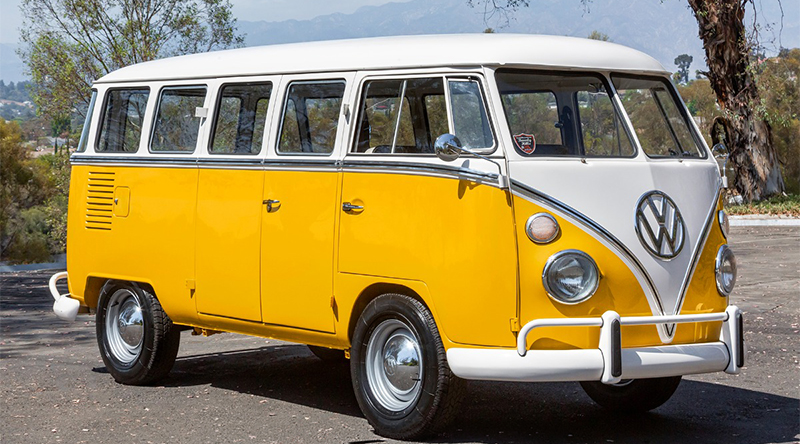
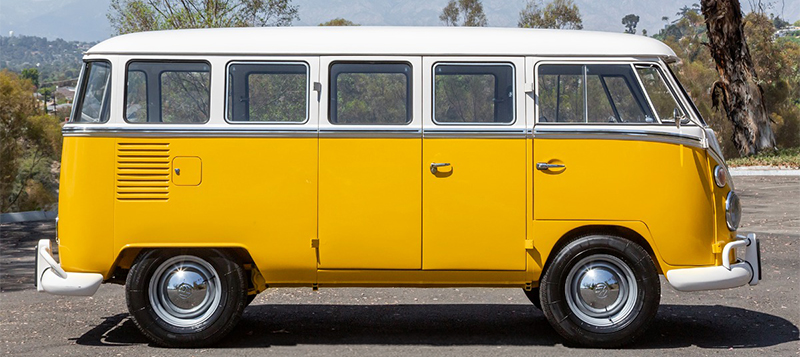
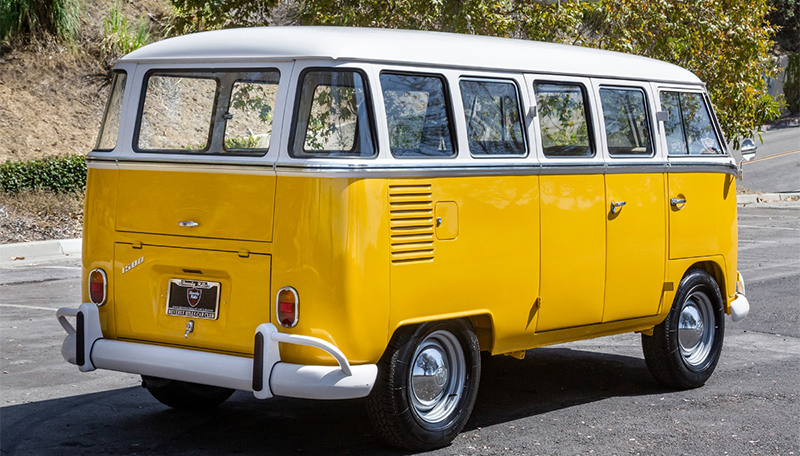
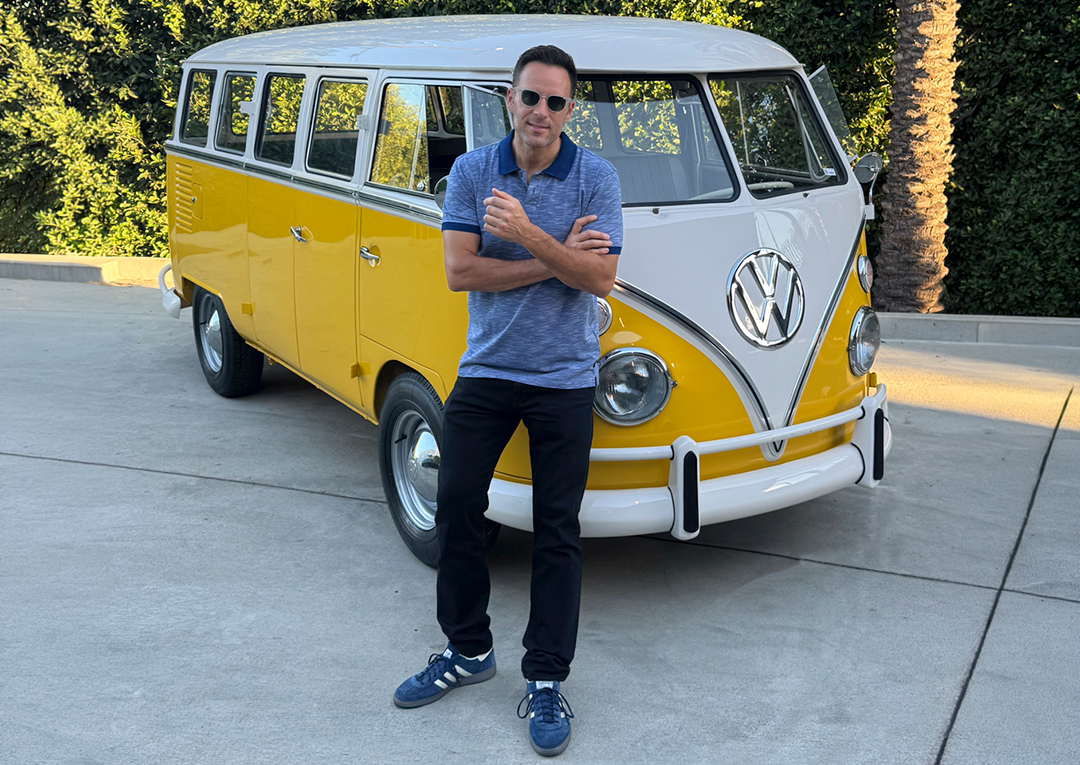
Our model is finished in a distinctive two-tone Bright Yellow and White color combination. This example features split front windshields, dual passenger-side cargo doors, rear-quarter vent louvers, chrome trim, and classic Volkswagen styling that has made the Type 2 one of the most recognizable vehicles of its era.
Power comes from a 1600cc air-cooled flat-four paired with a four-speed manual transaxle and single-barrel carburetor. The chassis is equipped with drum brakes, while the exterior retains the familiar Type 2 details, including white-finished bumpers, chrome trim, round headlights, and 15-inch steel wheels with Volkswagen-branded hubcaps.
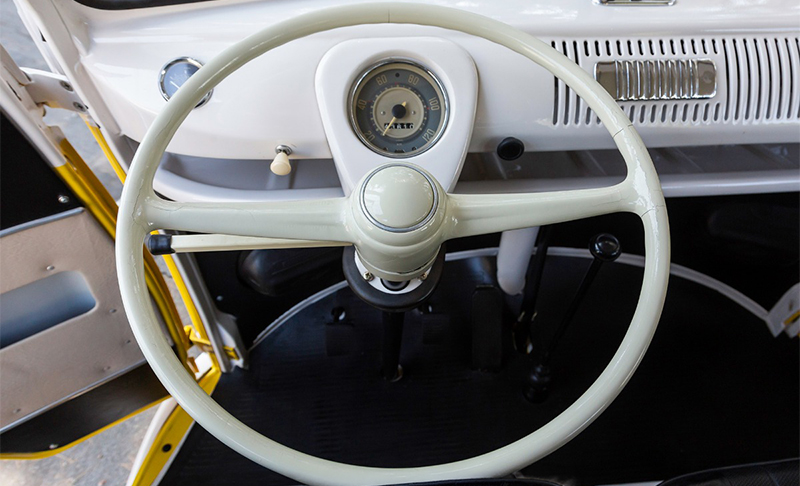
The combination of simple mechanical components and air-cooled power reflects the straightforward engineering that helped make the VW Bus so enduring. Inside, the Deluxe Bus offers a practical multi-passenger seating layout with a split front bench seat, pop-out windows, sliding windows, and front quarter vents. VDO instrumentation adds period-correct functionality, while the included spare tire and jack add useful equipment.
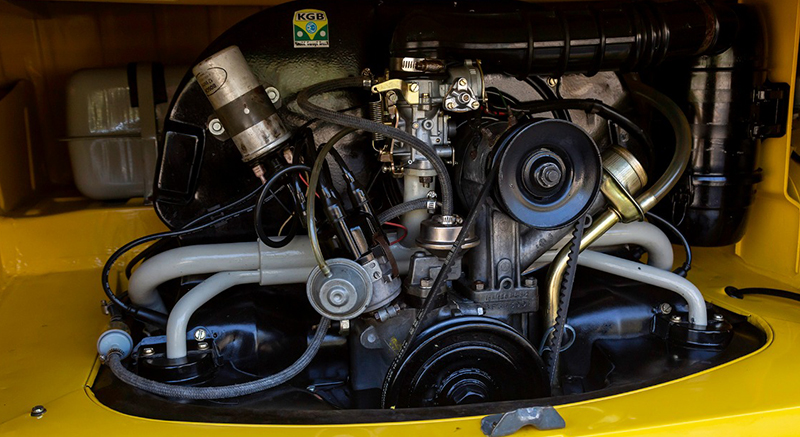
The 15-window configuration is especially recognizable for its additional side and rear glass, giving the Deluxe Bus a brighter and more open cabin while preserving the iconic shape of the classic Type 2. As a Brazilian-built example, it also represents the long production history of the Volkswagen Bus in South America, where the Type 2 continued to evolve after production ended in Germany.
With its distinctive two-tone finish, classic Volkswagen details, air-cooled flat-four, and four-speed manual transmission, this Type 2 Deluxe Bus offers an authentic example of the enduring Volkswagen Bus formula and is mechanically sound.
And whenever you’re driving our gorgeous Volkswagen Type 2 Deluxe Bus, with Crosby, Stills, Nash and Young blasting out of the speakers, don’t forget: Wear Your Freak Flag High!
-Alex Manos, Owner



Get Started!
Welcome!
join our inventory newsletter
Sign-up for our e-mail alerts
join our newsletter
Sign-up for our e-mail alerts
Learn More
or
we buy classic cars
Looking to sell yours?
Contact us
Sell us your car
Pick up from any USA location - Any condition - Top $$$ Paid


Chat With Us!



2 replies on “Car Tales: Freak Out, Volkswagen Type 2 Deluxe Bus”
We lived in Rio de Janeiro in the early 60s and my family owned a car rental business that comprised of eight Brazilian built beetles and three combis. I can remember sitting in the combi drivers seat, frustrated that I was too young to drive it. Who knew that it would become such an iconic car.
A fleet of Brazilian Beetles and Kombis in Rio! We’d love to see that lineup today. Thanks for the story!