 English
 Nederlands
 Français
 Deutsch
 Italiano
 Русский
 Español



 Facebook
 Youtube
 Twitter
 Instagram
 Pinterest
 LinkedIn
With its lugubriously onomatopoeic place-name of Huddersfield, the Yorkshire milltown would seem the living definition of that old northern English adage that ‘Where there’s muck there’s brass’ – in other words, that in the grimmest conditions may be found plenty of opportunities for profit.
Car Tales: Golden Eye, Aston Martin DB2 Vantage
With its lugubriously onomatopoeic place-name of Huddersfield, the Yorkshire milltown would seem the living definition of that old northern English adage that ‘Where there’s muck there’s brass’ – in other words, that in the grimmest conditions may be found plenty of opportunities for profit.
Should we therefore be surprised that one of the town’s favored sons, David Brown, who founded the Aston Martin supercar empire, also has a very profitable line of agricultural tractors?
Mind you, in truth all is by no means grim in Huddersfield. Until recently it had a successful – though now demoted – Premier League soccer team. And Huddersfield was also a significant venue in the early days of reggae music.
And where does reggae come from?
Jamaica.
And with what author and in which books is Jamaica thereby linked to David Brown and Aston Martin and thereby Huddersfield? Why, none other than Ian Fleming, of course, who wrote all of his James Bond superspy stories at Goldeneye, his hideaway on the north Jamaican coast.
And with what car was James Bond irrevocably linked in our minds? The Aston Martin. And especially the early models of the marque.
Although Aston Martins appeared in far fewer of the early Bond films than the myth suggests, the romantic existence of the fictional spy James Bond has been irrevocably associated with the Aston Martin motor-car. Ever since the appearance of Bond’s gadget-packed Dubonnet Red DB5 in the Goldfinger movie, the Aston Martin car has been seen almost as the personification of Bond.
Why was Bond fictionally given his prestigious motor-car, an Aston Martin DB2/4 mark 3, in the Goldfinger novel, written in early 1958? Because of the terrific reputation that the Aston Martin had already acquired: the superspy thereby was being associated with a marque that was considered the very highest of British quality. Now it is seen as a British cultural icon. (Incidentally, the Aston Martin was never built in David Brown’s home-town of Huddersfield – but we all have to come from somewhere…)
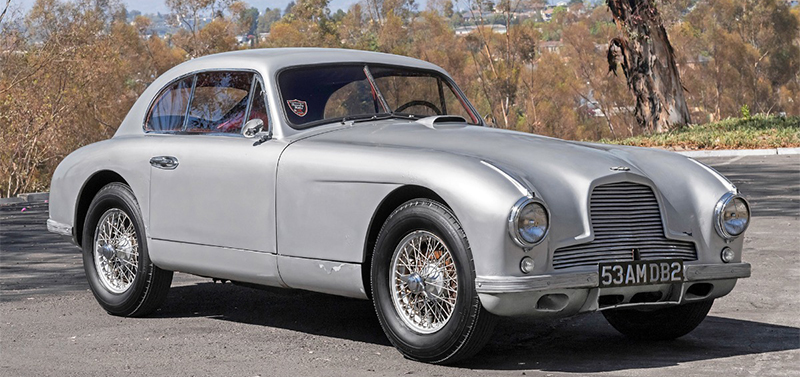
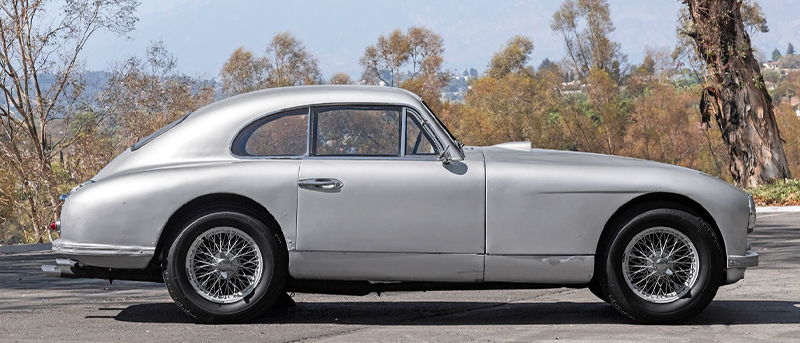
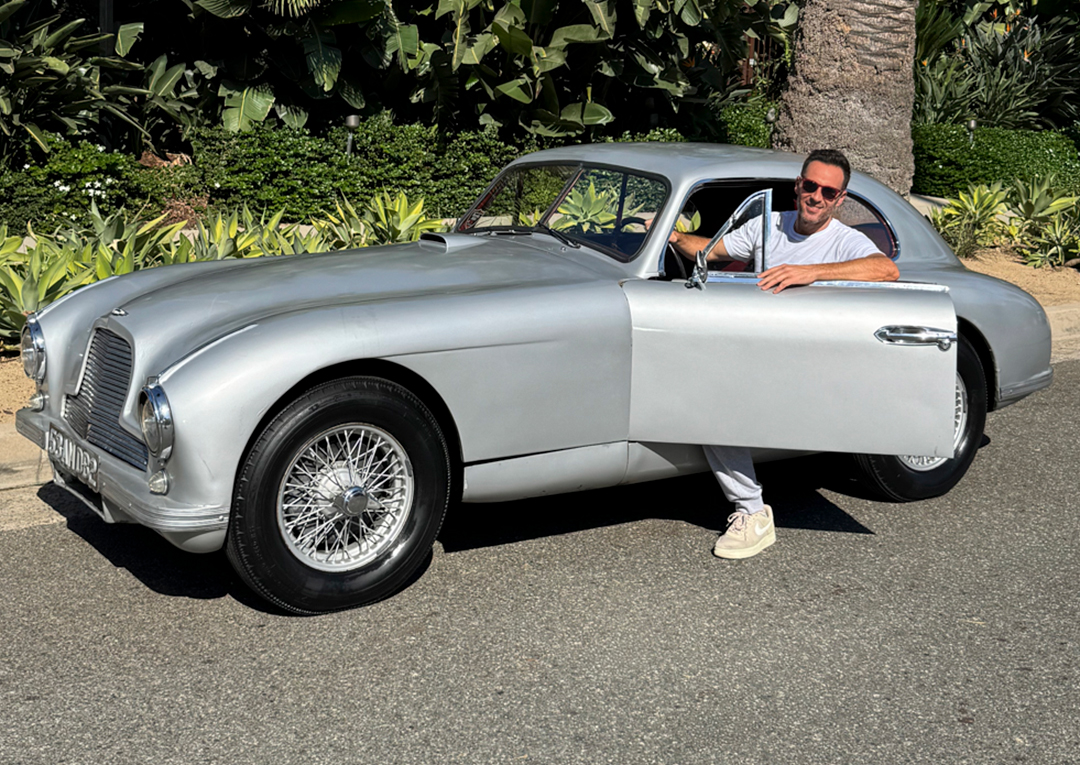
You may test out the early marque’s magic with a wonderful example we presently have at Beverly Hills Car Club, a 1953 Aston Martin DB2 Vantage Saloon Left-Hand Drive 4-Speed, finished in silver over a rich red interior. As one of Aston Martin’s most significant early postwar grand touring models, the DB2 Vantage combines handcrafted British craftsmanship with sporting performance, making it one of the marque’s most sought-after classics.
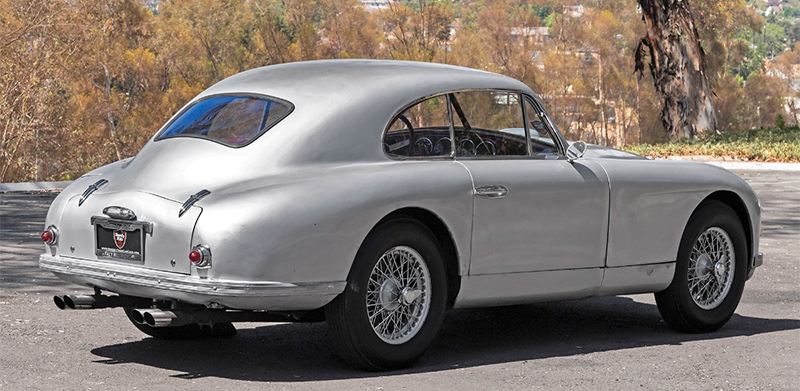
Power comes from an inline-6 engine, paired with a 4-speed manual transmission and fed by SU dual carburetors. Additional equipment includes Smiths instrumentation, a 3-spoke steering wheel, four-wheel drum brakes, a quad-tip exhaust outlet setup, chrome trim, a period-style front bumper with a British registration plate, and the distinctive dual split windshield with rubber gasket trim.
Riding on 16-inch multi-spoke knock-off wire wheels wrapped in Dunlop Road Speed RSS tires, this DB2 Vantage retains the timeless appearance expected from one of Britain’s most celebrated sports saloons. A jack and spare tire are also included. Inside, the cabin features rich interior wood trim, manual-crank windows, and a padded luggage platform/shelf behind the front seats, blending period elegance with grand touring practicality.
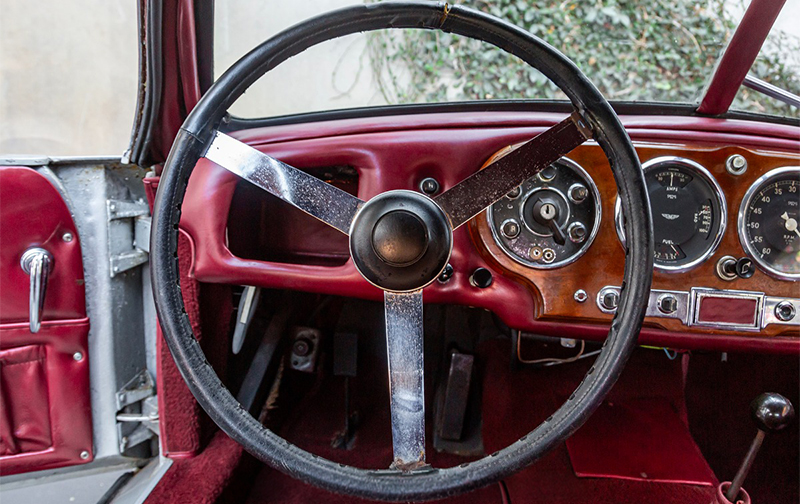
A fascinating fact about the Aston Martin DB2 Vantage is that its high-performance engine was developed from the same W.O. Bentley-designed Lagonda twin-cam engine that helped shape Aston Martin’s racing success during the early 1950s, including the foundation for the cars that would later achieve victory at Le Mans. This example will benefit from cosmetic refurbishment to bring it back to its original splendor, though it can also be enjoyed in its present condition while improvements are made over time.
A rare and highly desirable left-hand-drive example, this Aston Martin DB2 Vantage represents an important chapter in British automotive history, presenting an excellent opportunity for collectors and enthusiasts alike while remaining mechanically sound.
The DB2 debuted at the New York Auto Show in April 1950 and continued in production until April 1953, by which time 411 had been made. The first 49 had a chrome-framed front grille in three separate parts, and large rectangular cooling vents in the front wings. Subsequent cars had a one-piece grille with horizontal chrome slats, and no side vents.
The single-piece bonnet was hinged at the front. At the rear of the fixed-head coupé (FHC) a small top-hinged lid gave access to the spare wheel, and luggage space was behind the front seats, accessible only from inside the car.
Later in 1950, a Drophead Coupé (DHC) variant was introduced. At least 102 were built.
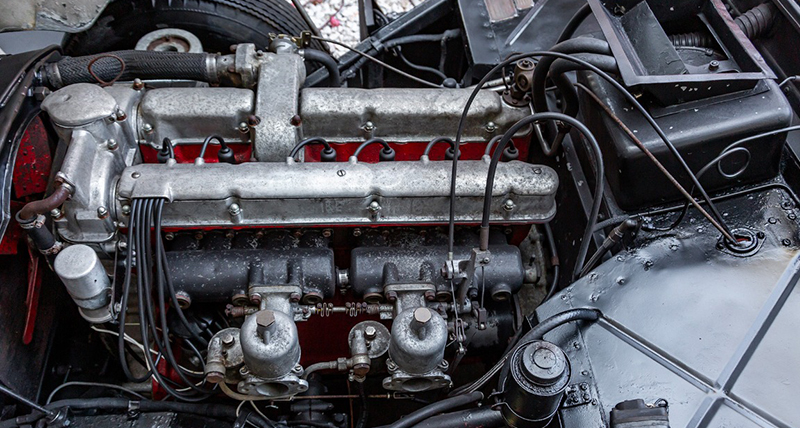
In April 1950, an engine with larger carburettors, inlet camshaft the same as the exhaust (for increased duration), and higher compression ratio pistons (8.16:1) was made available – the model we have at Beverly Hills Car Club. Aston Martin’s first Vantage upgrade option, it offered 125 hp (93 kW). Initially the higher compression ratio made the engine unsuitable for the British market, as the postwar austerity measures of the early 1950s restricted UK vehicles to 72 octane ‘Pool petrol’. The first DB2 Vantage, LML 50/21, was delivered to, and raced by, Briggs Cunningham in the United States.
A closed coupé tested by the British magazine The Motor in 1950 had a top speed of 116.4 mph (187.3 km/h) and could accelerate from 0-60 mph (97 km/h) in 11.2 seconds. A fuel consumption of 20 miles per imperial gallon (14 L/100 km; 17 mpg‑US) was recorded.
The test car cost £1914 including taxes.
-Alex Manos, Owner



Get Started!
Welcome!
join our inventory newsletter
Sign-up for our e-mail alerts
join our newsletter
Sign-up for our e-mail alerts
Learn More
or
we buy classic cars
Looking to sell yours?
Contact us
Sell us your car
Pick up from any USA location - Any condition - Top $$$ Paid


Chat With Us!