 English
 Nederlands
 Français
 Deutsch
 Italiano
 Русский
 Español


 Facebook
 Youtube
 Twitter
 Instagram
 Pinterest
 LinkedIn
The XK120 was the opening salvo in a range of cars from the legendary Jaguar marque that climaxed in the XKE, the almost mythical ‘E’ Type. Three austerity-dominated years after the end of World War II, the gorgeous XK120 was daringly launched at the 1948 London Motor Show, a testbed and show car for the new XK engine designed by Chief Engineer William Heynes –architect of its fabulous sultry look.
Car Tales: Legend, Jaguar XK120

The Jaguar XK120 was the opening salvo in the range of fabulous cars from the legendary British Jaguar marque that climaxed in the XKE, the almost mythical ‘E’ Type. Three austerity-dominated years after the end of World War II, the gorgeous XK120 had been daringly launched at the 1948 London Motor Show, a testbed and show car for the new Jaguar XK engine that had been designed by Jaguar Chief Engineer William Heynes – the architect of its fabulous sultry look.
Unsurprisingly the sports car caused a sensation, which persuaded Jaguar founder and Chairman William Lyons to put it into production, the fastest production car in the world at the time.
Not bad for a business that had begun adapting post-World War I army surplus motorcycle sidecars. But we’ll come to that…
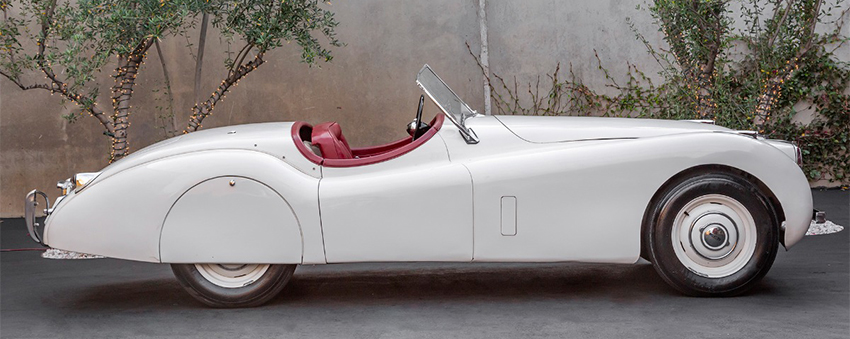
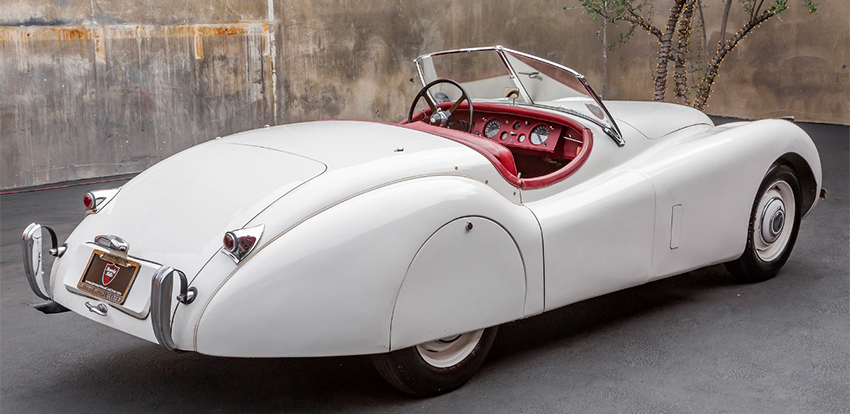
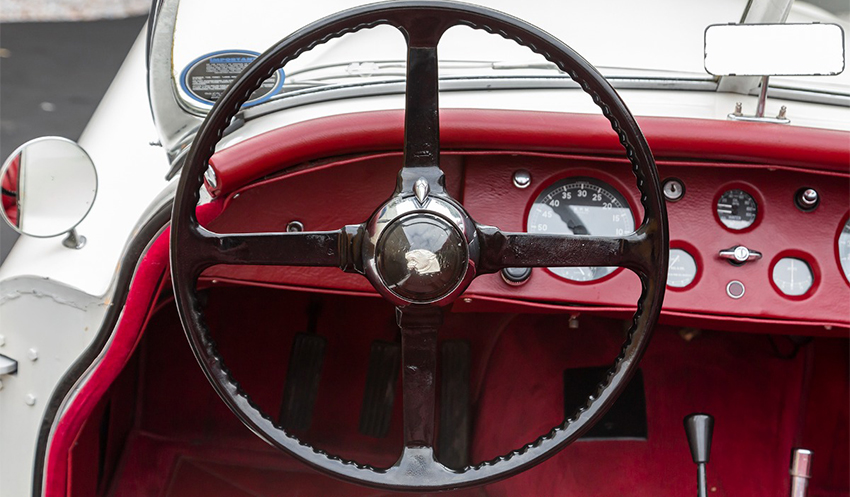
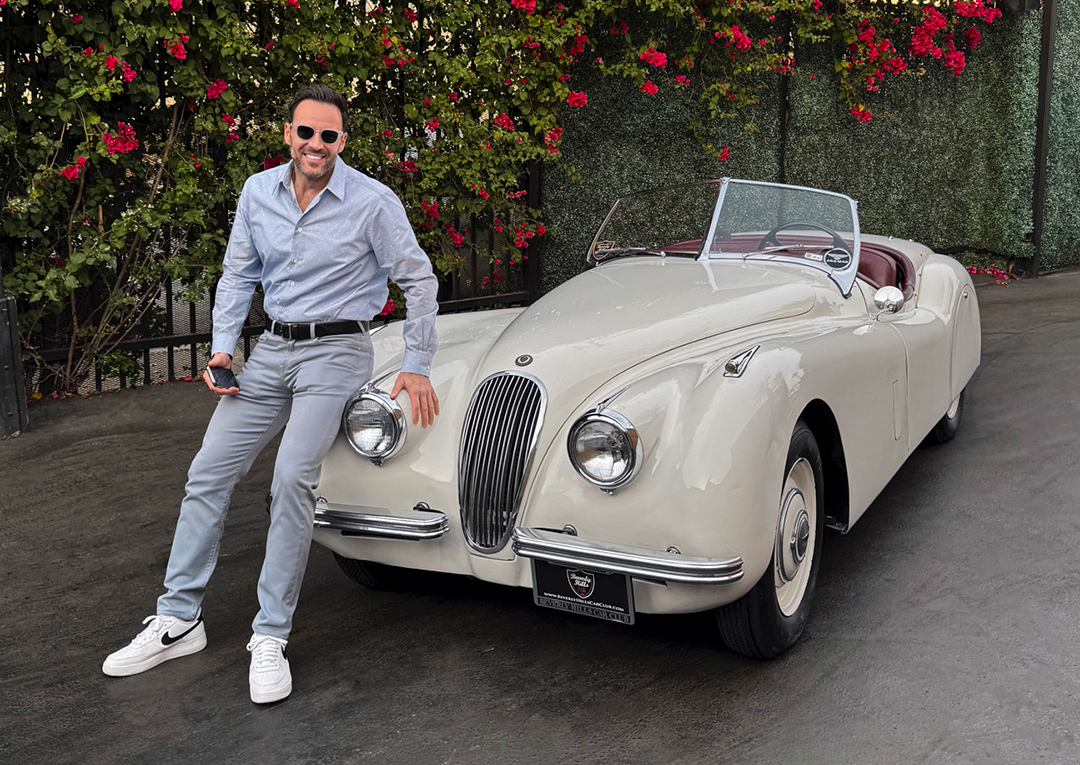
We have a splendid example of an XK120 right now at Beverly Hills Car Club, a 1952 Jaguar XK120 Roadster featured with matching numbers. Finished in Old English White, complemented with a red interior, this iconic classic car is a true gem, boasting timeless elegance and unparalleled performance that cannot fail to captivate any enthusiast’s heart.
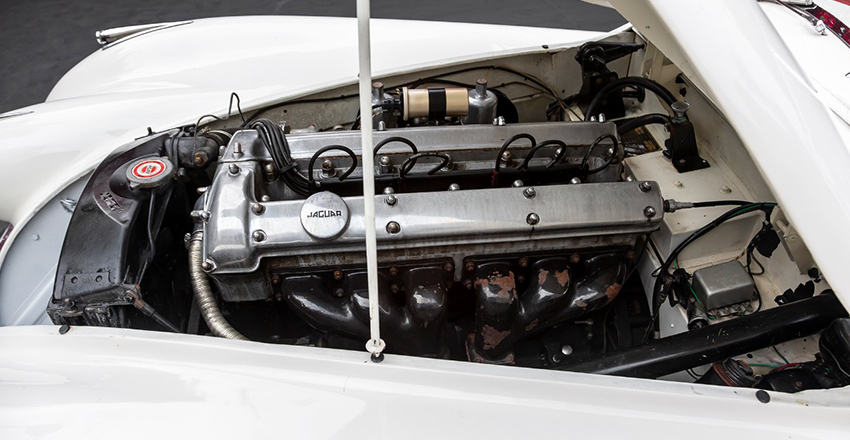
Our XK120 Roadster is equipped with a 4-speed manual transmission, 3 1/2-liter engine, Birmingham SU carburetors, single exhaust outlet, Smiths instrumentation, chrome bumpers, split windshield, convertible soft top, Tonneau cover, four-spoke steering wheel, Michelin tires, jack, and full-size spare tire fitted in the trunk. Convenience features include low-back bucket seats, side curtains, dash-mounted rearview mirror, passenger dash grab handle, door pockets, and a fender-mounted side mirror.
This particular example includes manufacturer’s literature and receipt copies totaling over $10,000 that have been invested into the vehicle. In addition to its stunning design, this particular XK120 comes with a unique feature that sets it apart from the rest. This British classic includes a plaque that “Certified that this Jaguar car is an exact replica of the record-breaking car which achieved the speed of 132.6 M.P.H. at Jabbeke, Belgium, 30 May 1949.” This Jaguar is fresh out of storage and currently not running, presenting a unique opportunity for enthusiasts to recommission it to its former glory and enjoy the thrill of owning a piece of automotive history.
As stated above in our car’s plaque, at the time of its debut the XK120 was the world’s fastest production car, timed through the flying mile by the Royal Automobile Club of Belgium at 132.6 mph. There was nothing like it, and after its arrival it was impossible to overlook.
But there was some history behind the company that built this revolutionary car.
And it was personified in William Lyons, born in 1901, later Sir William Lyons, who was to become known as ‘Mr Jaguar’. Born in Blackpool, a celebrated seaside resort town in the north-west of England, Lyons had obtained an engineering apprenticeship at Crossley Motors in nearby Manchester.
In 1921 Lyons met William Walmsley, a fellow motorcycle enthusiast who in his garden shed was converting World War I army-surplus motorcycles for civilian use and making aesthetically attractive sidecars. Lyons admired the sidecars and bought one. Lyons and Walmsley obtained from their fathers a then substantial £500 bank guarantee to go into business. On his 21st birthday in 1922 – meaning he had become of legal age – Lyons formed a partnership with Walmsley.
The business they co-founded was called Swallow Sidecars and had a staff of ‘three men and a boy’.
The company manufactured stylish sidecars. But the first Swallow bodied car was quite unofficial, Walmsley having obtained the burnt-out remains of an Austro-Daimler car and brought it to the factory to be re-bodied by his employees.
After 1927 the company began to make increasing numbers of low cost coach-built cars, especially the Austin Seven Swallow which the Blackpool factory produced at the rate of 12 per week. This upwards move to coach-built cars had been driven by how, as in the manner of the age and perhaps inspired by that Austro-Daimler, Lyons had decided to ‘improve’ a version of the already popular Austin 7, creating a re-bodied model of the best-selling car.
Buying a chassis from dealer Parkers of Bolton, Lyons commissioned Swallow’s talented employee, coachbuilder Cyril Holland, to produce a distinctive open tourer: the Austin Seven Swallow, distinguished by its fully rounded back – ‘dome-shaped’, as it was fashionably known, the height of saloon car fashion of the day. Holland, who joined Swallow in late 1926, had served his apprenticeship with the Birmingham car-makers Lanchester and would become Swallow’s chief body engineer.
With its bright two-tone colors and a style befitting more expensive cars of the time, together with its low cost of £175, the Swallow proved popular and was followed in 1928 by a saloon version: the Austin Seven Swallow Saloon. Following moves to larger premises in Blackpool, in 1928 Lyons moved the company and his family to Coventry in the English Midlands, which was becoming an area known for the manufacture of motorcars.
Approximately 3,500 bodies of various styles were produced until 1932, when Lyons started making complete cars under the marque of SS Cars, by now being manufactured in Coventry. In 1935 William Walmsley left the company.
It was, therefore, the success of the Swallows that laid the foundations of what was to become, by 1945, Jaguar Cars, a name-change largely motivated by unfortunate World War II connections with the term ‘SS’.
And thereby came the utter triumph – at every level – of the XK range.
And accordingly the wonderful 1952 model we have right now at Beverly Hills Car Club.
-Alex Manos, Owner

Get Started!
Welcome!
join our inventory newsletter
Sign-up for our e-mail alerts
join our newsletter
Sign-up for our e-mail alerts
Learn More
or
we buy classic cars
Looking to sell yours?
Contact us
Sell us your car
Pick up from any USA location - Any condition - Top $$$ Paid


Chat With Us!