 English
 Nederlands
 Français
 Deutsch
 Italiano
 Русский
 Español



 Facebook
 Youtube
 Twitter
 Instagram
 Pinterest
 LinkedIn
Newly launched in 1966, the exotic name of the then newly announced – and exotic in all elements – Chevrolet Camaro would appear to have been a twist on the French word ‘camarade,’ meaning a true buddy.
Car Tales: Mustang Eating, Chevrolet Camaro Z-28 4-Speed
It was GM’s public relations operation that spun the line that Camaro ‘suggests the comradeship of good friends, as a personal car should be to its owner.’
Newly launched in 1966, the exotic name of the then newly announced – and exotic in all elements – Chevrolet Camaro would appear to have been a twist on the French word ‘camarade,’ meaning a true buddy. It was GM’s public relations operation that spun the line that Camaro ‘suggests the comradeship of good friends, as a personal car should be to its owner.’
It was also a significant name that had drawn together – only 21 years previously at the time of the car’s birth – those in the French World War 2 resistance, those involved against the Nazis.
In The Complete Book of Camaro: Every Model Since 1967, it was explained that – presumably taking a break from watching paint dry – Chevrolet merchandising manager Bob Lund and General Motors vice president Ed Rollett with great diligence had been going through a pre-World War 2 edition of Heath’s French and English Dictionary. There they allegedly came across the word ‘camaro.’
Finally agreed upon and sanctified by then General Manager Elliot M. ‘Pete’ Estes, later to become President of General Motors, Estes declared: ‘Chevrolet has chosen a name which is lithe and graceful….in keeping with our other car names beginning with “C.” It suggests comradeship of good friends, as a personal car should be to its owner.’
But then there was a further PR shot from the motoring giant that was designed as satire: that the name Camaro refers to ‘a small, vicious animal that eats Mustangs.’ A rather good position to take, as it suggested a car with a sense of humor, excellent in the camaraderie stakes.
Yet enough of the nomenclature: what is on the inside of the Chevrolet Camaro?
The Camaro was a sporty coupe and convertible based on the Chevy Nova platform, but with some powerful engine options including a 396 cubic inch V8 making up to 375bhp. Significantly the Chevrolet Camaro was also really designed to juxtapose and rival the already popular Ford Mustang as an American icon car with what would become another legendary muscle car.
Approached by Chevrolet’s marketing team with a highly sophisticated, tongue-in-cheek flair on the edge of Madmen genius, GM seriously worked up the September 29 1966 premiere of the 1967 model of the Camaro: this was a serious endeavour to create an American icon car – what would become a legendary muscle car – that would rival the Ford Mustang, rampantly successful since its launch in 1964. And this conscious rivalry paid off.
Along with the Ford Mustang, the Chevrolet Camaro led to the rise of ‘muscle cars’ in the United States. The Camaro is one of those budget sports cars that deliver an astonishing performance at an affordable price. Asides from the Ford Mustang, the Chevrolet Camaro is one of the bestselling American-made sports cars.
Indeed, in releasing the Camaro, Chevrolet hoped to compete with the wildly successful Ford Mustang. And the similarity between the Camaro and the Mustang at inception was strong. For example, the Camaro had the same rear-wheel-drive and front-engine layout found on the earlier Mustangs. Buyers could get the Camaro either as a sport coupe, with 2+2 seating, or as a convertible. Both models have always used RWD and a collection of V8 and V6 engines.
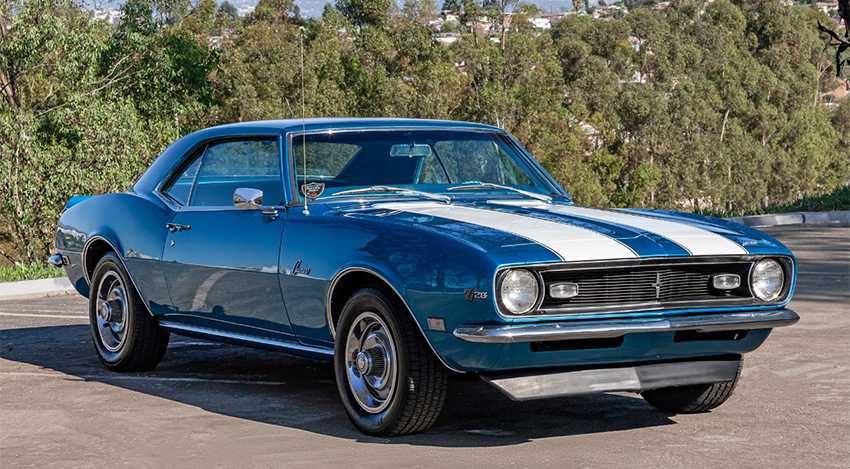
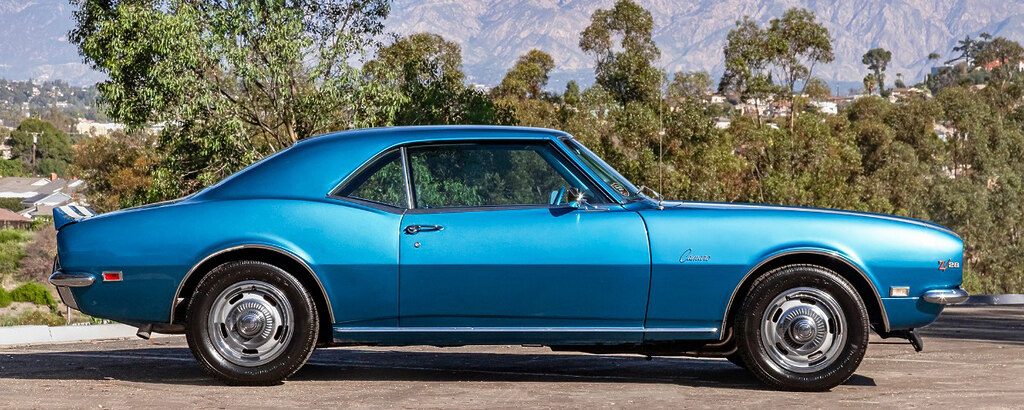
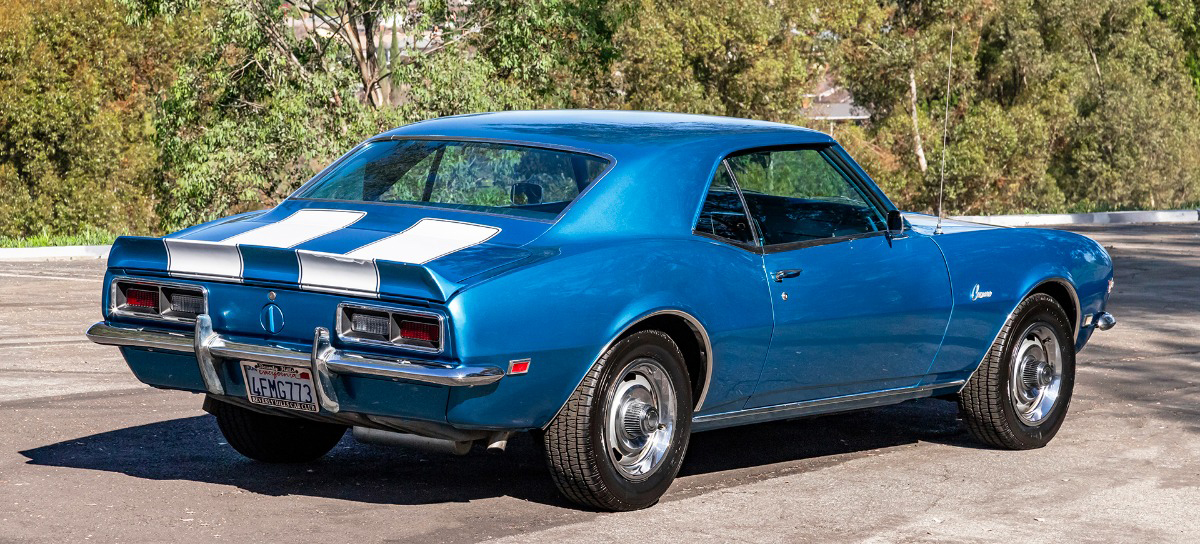
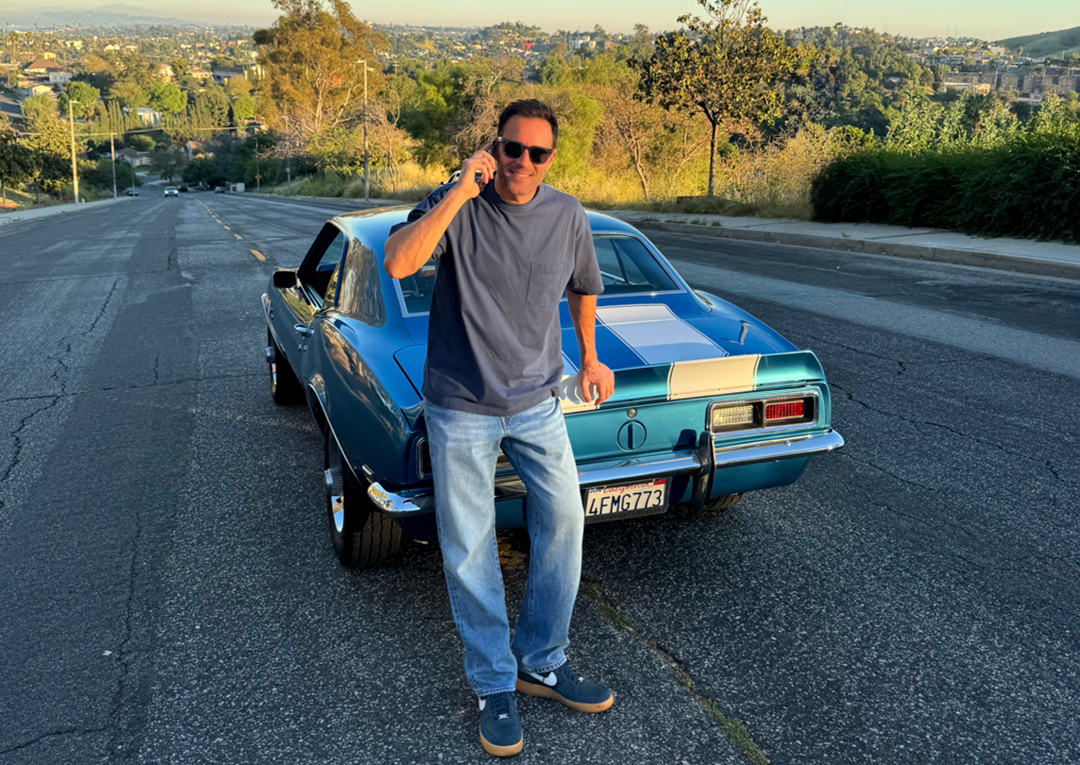
We have a splendid example of a Chevrolet Camaro right now at Beverly Hills Car Club, a very spectacular 1968 Chevrolet Camaro Z28 4-Speed, a true icon of the golden age of American muscle. Finished in its factory-correct LeMans Blue (U) exterior, this Camaro wears its legendary Z/28 dual racing stripes with pride, perfectly contrasted by the correct blue (717) interior. The stance, the color, and the attitude all come together to create a car that commands admiration from every angle.
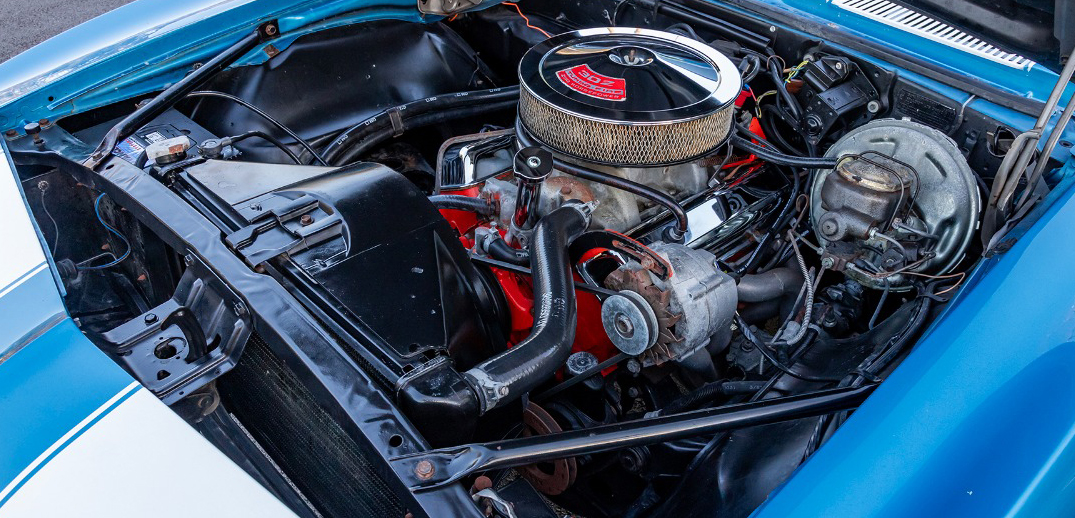
Powered by a 302ci V8, fed by a Holley four-barrel carburetor, and mated to a desirable 4-speed manual transmission with a Hurst shifter. Built with racing in mind, the 302 was developed specifically to meet SCCA Trans-Am homologation rules. Making the Z/28 more than just a street machine, it was a factory-built track weapon. Although officially rated at 290 horsepower, these engines were notoriously underrated and engineered to thrive at high RPM, earning a reputation for their thrilling top-end performance.
Supporting features include dual exhaust outlets, power steering, Z/28 badging, a front chin spoiler, rear decklid spoiler, and a jack and spare tire.
The car rides on 15-inch Rally wheels with chrome beauty rings and classic Derby-style center caps, wrapped in BFGoodrich tires that complete the period-correct look.
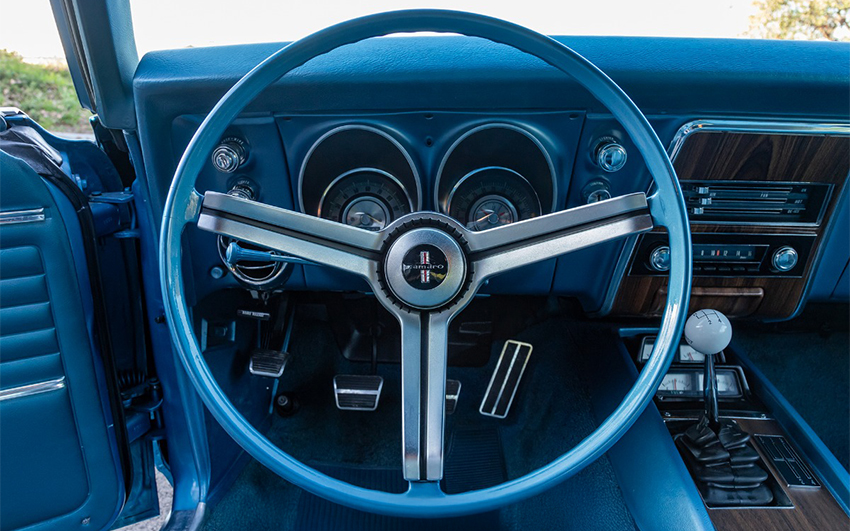
Inside, the cabin delivers an unmistakable late-’60s driving experience. Front bucket seats and a rear bench provide comfortable seating, while dual side mirrors and manual crank windows preserve the car’s vintage character.
The push-button radio, fender-mounted antenna, and iconic 3-spoke steering wheel reinforce the nostalgia, while thoughtful details like the center console and glove compartment add everyday usability. Every element feels purpose-built, driver-focused, and true to the Z/28’s racing heritage.
This is more than just a classic Camaro; it’s a documented piece of performance history
-Alex Manos, Owner



Get Started!
Welcome!
join our inventory newsletter
Sign-up for our e-mail alerts
join our newsletter
Sign-up for our e-mail alerts
Learn More
or
we buy classic cars
Looking to sell yours?
Contact us
Sell us your car
Pick up from any USA location - Any condition - Top $$$ Paid


Chat With Us!