 English
 Nederlands
 Français
 Deutsch
 Italiano
 Русский
 Español



 Facebook
 Youtube
 Twitter
 Instagram
 Pinterest
 LinkedIn
Pantera is Spanish for panther. In South & Central America, where they mostly live in rainforests, but also in savannas, swamps, grasslands, forest, desert and other areas, they are often known as jaguars, one of whose role in life is to be ambush predators. When hunting, they usually try to secretly get very close to the prey, and then the panther suddenly jumps at it and throws it down.

Car Tales: Prey For Me, De Tomaso Pantera
Pantera is Spanish for panther. In South & Central America, where they mostly live in rainforests, but also in savannas, swamps, grasslands, forest, desert and other areas, they are often known as jaguars, one of whose role in life is to be ambush predators. When hunting, they usually try to secretly get very close to the prey, and then the panther suddenly jumps at it and throws it down.
The panther bites the skull of its prey to kill it. Then it takes the prey to a safe place and eats it. The panther has a very powerful strong bite, even compared to other big cats.
So Pantera would seem to be an apt name for a big car, and one that was definitively a supercar, biting down hard on roads. Especially a supercar created by an individual with a thick vein of glamorous romance in his back story. Alejandro de Tomaso was an Italy-based Argentine racing driver who started producing sports cars under his own name in the 1960s.
So the De Tomaso Pantera was not just Italian and American, but courtesy of the owner’s nationality also had an additional streak of South American sultriness – so the name of his third launch of supercar shouldn’t be surprising, especially considering the bossman’s history.
After being implicated in 1955 in a plot to overthrow Juan Peron, the Argentine president, De Tomaso had fled to Italy, from where his paternal grandfather had emigrated. Settling in Modena, he married Isabelle Haskell, a wealthy and socially connected American heiress, herself a racing-driver. With Isabelle he founded the De Tomaso motor-car company; it produced not only single-seater racing cars but also exotic sports models as well as a pair of performance saloons: the Longchamp and the Deauville were in production in the 1970s at the same time as the De Tomaso Pantera, both the saloons named after French racecourses, a further interest of the former Isabelle Haskell.
De Tomaso’s first road-going production model was named after the motor racing circuit north of Rome, the Vallelunga. It was introduced in 1963, with around 60 being built.
The Mangusta, introduced in 1966, was the first De Tomaso produced in significant numbers. With the Mangusta, De Tomaso moved from European to American Ford engines. The car had a 4.7-litre iron-block V8 engine and steel and aluminium coupé bodywork from Ghia – an Italian coachbuilder also controlled by Alejandro de Tomaso.
About 400 Mangustas were built before production ended in 1971.
In 1971 the Mangusta was succeeded by the Pantera. The Pantera had a 351 Cleveland Ford V8 and a low, wedge-shaped body designed by Ghia’s Tom Tjaarda. Through an agreement with Ford, De Tomaso sold Panteras in the USA through Ford’s Lincoln-Mercury dealers. Between 1971 and 1973, 6,128 Panteras were produced in Modena, the largest number of cars De Tomaso produced. The 1973 oil crisis and other factors compelled Ford to pull out of the Pantera deal at the end of 1973, a few months after buying all of De Tomaso’s shares and getting control of the entire production process in the three factories that shared the workload in northern Italy.
But De Tomaso retained from Ford the right to produce the car for the rest of the world market, so he continued Pantera production at a greatly reduced scale of fewer than 100 cars per year during the 1970s and 1980s. From then on, the cars were largely hand-built, even more than before.
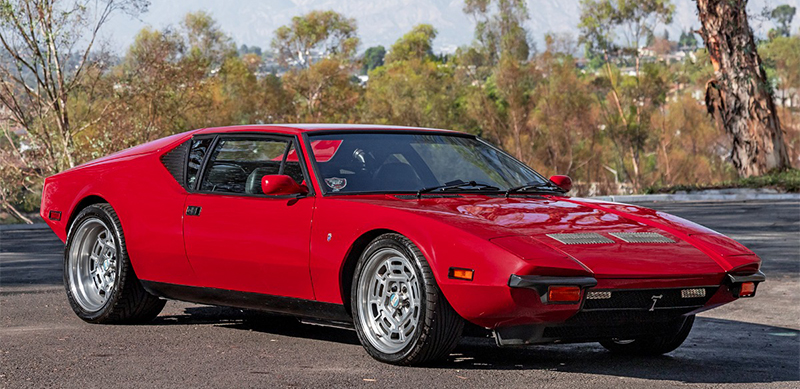
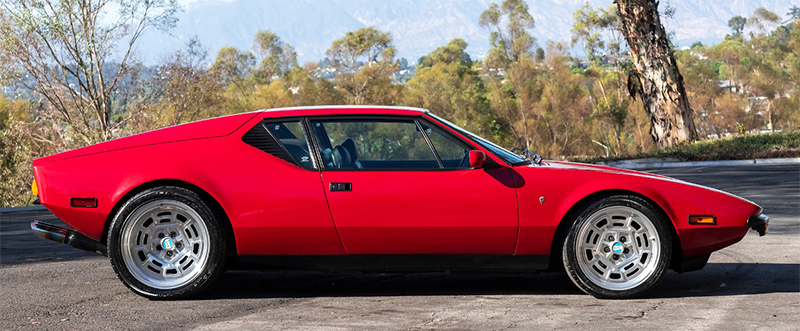
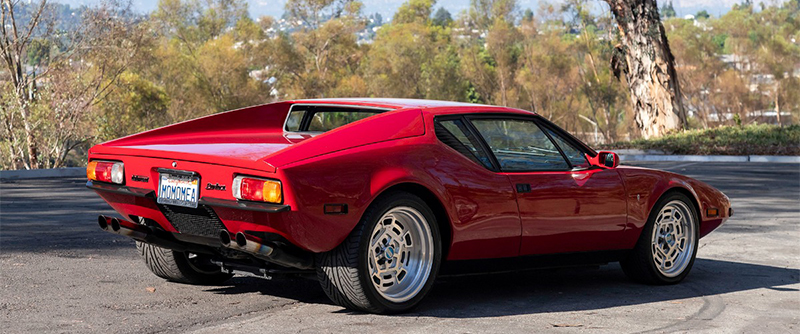
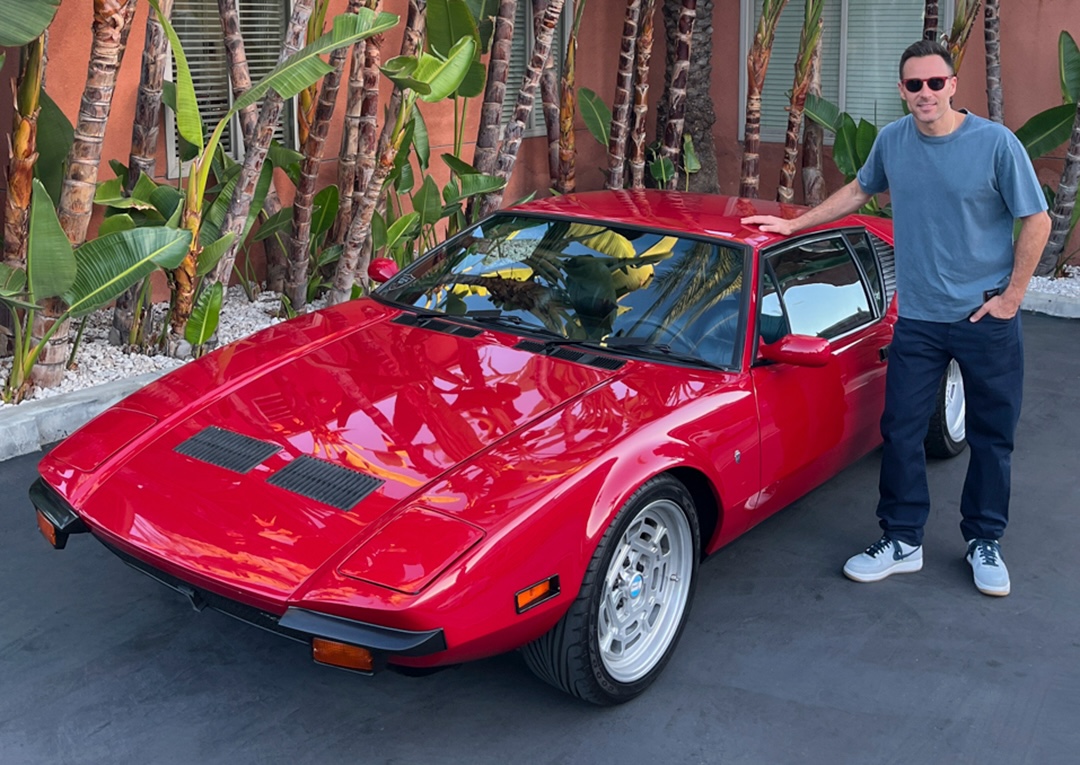
The car we presently have at Beverly Car Club is a 1971 Detomaso Pantera, the first year of production and combines Italian styling with American V8 performance, creating a distinctive Italian-American sports car that remains instantly recognizable.
Finished in red over a black interior, it captures the aggressive character and unique design that made the Pantera stand out in the 1970s.
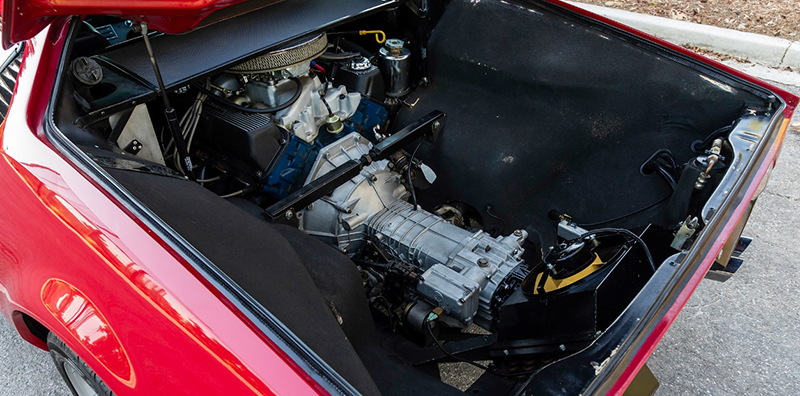
This California car is powered by a 351 CID 4V Ford Cleveland V8 paired with a 5-speed manual transaxle and gated shifter.
As I said, the Pantera was developed through a collaboration between De Tomaso and Ford, with Ford supplying the V8 engine while De Tomaso handled the chassis and Italian coachwork, creating a unique combination of European design and American performance.
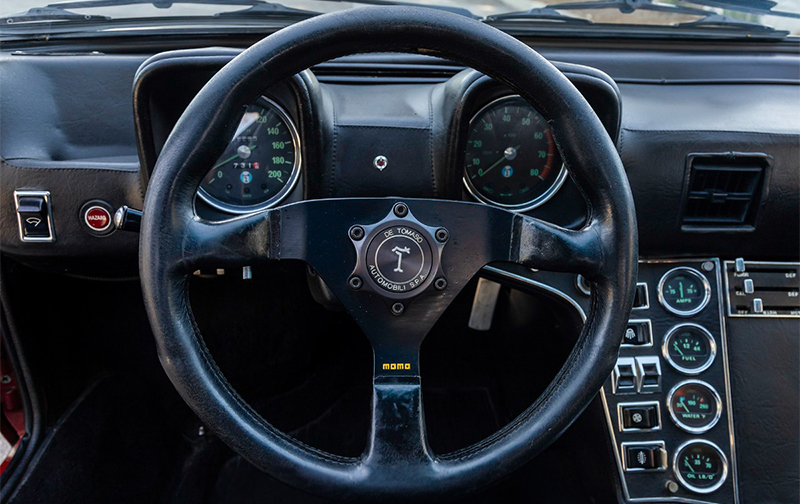
The exterior is equipped with retractable pop-up headlights, a rear split bumper, De Tomaso-logo center caps, and 17-inch front and 18-inch rear Campagnolo-style wheels. A dual twin-tip quad exhaust set-up emphasises its aggressive demeanor. Four-wheel disc brakes and a 3-spoke MOMO steering wheel further add to its performance-oriented character, while the Demon 4-barrel carburetor helps feed the Ford V8.
Inside, the cockpit features Veglia Borletti instrumentation, power windows, rocker switches, and a Panasonic radio. The gated shifter and period-style instrumentation add to the distinctive driving experience that has made the Pantera such a fascinating part of 1970s automotive history. Receipt copies totaling $43,359.57 are included, documenting significant expenditures on the car.
This 1971 De Tomaso Pantera presents an opportunity to own a unique Italian-American sports car with its combination of Italian design, Ford V8 power, and 5-speed manual transmission, and is mechanically sound.
Take our Pantera for a test spin: you’ll be bitten!
-Alex Manos, Owner



Get Started!
Welcome!
join our inventory newsletter
Sign-up for our e-mail alerts
join our newsletter
Sign-up for our e-mail alerts
Learn More
or
we buy classic cars
Looking to sell yours?
Contact us
Sell us your car
Pick up from any USA location - Any condition - Top $$$ Paid


Chat With Us!