 English
 Nederlands
 Français
 Deutsch
 Italiano
 Русский
 Español



 Facebook
 Youtube
 Twitter
 Instagram
 Pinterest
 LinkedIn
Magic!

Car Tales: Stainless Steel, Excalibur Series IV Phaeton
No other word to describe the 1980 Excalibur Series IV Phaeton that we presently have at Beverly Hills Car Club. And as much as anything we’re talking about the Excalibur legend and its place in English Arthurian romance.

Magic! No other word to describe the 1980 Excalibur Series IV Phaeton that we presently have at Beverly Hills Car Club. And as much as anything we’re talking about the Excalibur legend and its place in English Arthurian romance.
How King Arthur – he of the Knights of the Round Table – won the English throne by pulling a sword, named Excalibur, from an anvil sitting atop a stone that appeared in a churchyard on Christmas Eve.
‘Whoso pulleth out this sword of this stone and anvil, is rightwise king born of all England.’ So wrote Thomas Mallory of the provenance of Excalibur in Le Morte d’Arthur, his magnificent 15th century version of the Arthurian tales.

It was said that when Excalibur was first drawn in combat, in a battle testing King Arthur’s sovereignty, its blade shone so bright it blinded his enemies.
Just what you might like from your 1980 Excalibur Series IV Phaeton.
The Excalibur automobile was a car styled after the 1928 Mercedes-Benz SSK by Clifford Brooks Stevens for Studebaker. There is an interesting back-story here, for the SSK was the last car designed for Mercedes-Benz by Ferdinand Porsche before he left to found his own company – I bet you can’t figure out what that business might have been called…
Clifford Brooks Stevens subsequently formed a company to manufacture and market the cars, which were a standard Studebaker car with special bodywork (and soon with an upgraded engine). The Excalibur has a Neoclassic design, a term used to designate automobiles produced in the 1960s to 1990s in the flavor of the elegant and prestigious style cars of the 1920s and 1930s.
A prototype Excalibur premiered at car shows in 1963, fitted on a Studebaker Lark Convertible chassis and employing a 290-brake-horsepower Studebaker 289 V-8. But Studebaker ceased engine production in December 1963 and, consolidating all manufacturing to its Hamilton, Ontario, plant, ended the availability of that engine.

Stevens subsequently obtained engines from General Motors. These were Chevrolet 327s in 300-brake-horsepower (300 PS; 220 kW) Corvette tune, making the 2,100-pound (950 kg) Excalibur a strong performer. With the standard 3.31:1 rear axle, acceleration from 0–60 mph (0–97 km/h) took less than six seconds. Projected top speed was 134 mph (216 km/h).
Over 3,500 Excalibur cars were built, all in Milwaukee, Wisconsin.

Three series of Excaliburs had been produced over a 16 year period by the time the Excalibur Series IV went into production, introduced for the 1980 model year. The Series IV received a new chassis that was 13 inches longer than its predecessor, with a 125-inch wheelbase, but still available in a roadster or phaeton body style. A range of updates were featured on the Series IV as well as the first significant styling update in the cars’ production.
The Series IV saw the Excalibur shift more towards an emulation of the Mercedes 540K rather than the Mercedes SSK, which had previously held the most similar aesthetic: these Excalibur Series IV cars were known for extensive power amenities in the cockpit and a more flowing style of bodywork.
Also new was the GM-sourced 5.0L (305ci) V8 engine that was exclusively paired to an automatic transmission to send drive to the rear wheels. Production of the Series IV Excalibur ended in 1984 when it was replaced by the Series V Excalibur.
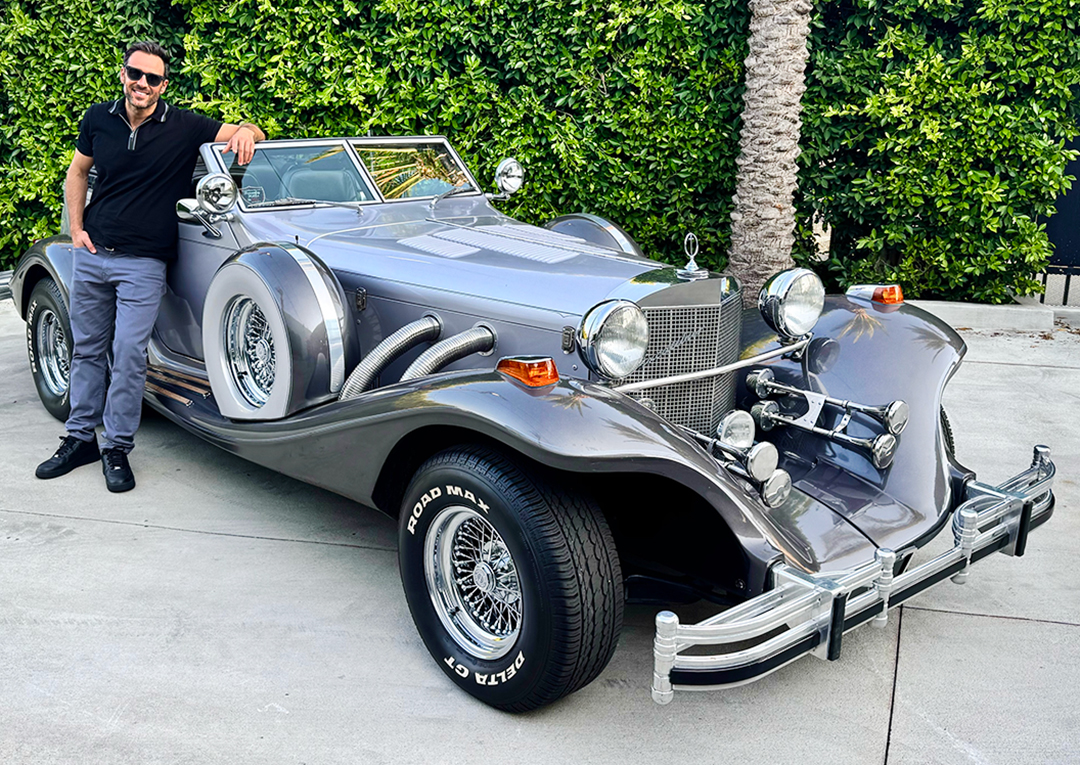
The 1980 Excalibur Series IV Phaeton we presently have at Beverly Hills Car club is featured with 30,538 miles on the odometer. This beautiful car is finished in a silver exterior color with gray fenders combined with a black interior. A convertible hard-top is included, offering the option of an open-air experience. This classic is a true testament to the craftsmanship and opulence that Excalibur is renowned for.

The car comes equipped with an automatic transmission, V8 engine, front-wheel disc brakes, VDO instruments, dual exhaust outlets, quad trumpet horns, Hella taillights, fog light, chrome trim/grille/bumpers, Delta GT Road Max white-letter tires, 15-inch chrome wire wheels, and dual side-mounted spare tires. One of the most striking features of the Excalibur are its fenders with hood exhaust vents. Featured amenities include front bucket seating, FM/AM radio, dual-side rearview mirrors, and dual spotlights. It is important to note that while the power convertible soft top moves, it will require additional service to be fully operational, a factor that has been considered when pricing.
In addition, this roadster comes with owner’s manual and service receipt copies of $13,372.56 dating between May 2015 through December 2018. This is an excellent opportunity to jump into the ownership of this neo-classical Excalibur that is mechanically sound.
For his part, in 1944 Clifford Brooks Stevens formed The Industrial Designers Society of America.
After his death in 1995, the New York Times called him ‘a major force in industrial design.’
-Alex Manos, Owner



Get Started!
Welcome!
join our inventory newsletter
Sign-up for our e-mail alerts
join our newsletter
Sign-up for our e-mail alerts
Learn More
or
we buy classic cars
Looking to sell yours?
Contact us
Sell us your car
Pick up from any USA location - Any condition - Top $$$ Paid


Chat With Us!