 English
 Nederlands
 Français
 Deutsch
 Italiano
 Русский
 Español


Final-year production status does specific things to a collector car’s market position, and not all of them are obvious. The straightforward version — last year commands a premium, full stop — is true as far as it goes, but it doesn’t go far enough to be useful to a seller trying to understand what they actually have.
1963 MERCEDES-BENZ 190SL, SELLING THAT CLASSIC

The 1963 Mercedes-Benz 190SL closed the W121 production run after nine years and just over 26,000 cars. Mercedes had already introduced the 230SL Pagoda by the time the last 190SLs were leaving Stuttgart, and the transition was visible enough that buyers in the market knew what was coming. The 1963 190SL didn’t go out quietly or without notice — it went out with the market paying attention, which shaped the ownership culture around these final examples in ways that are still legible today.
Call Beverly Hills Car Club: 310-975-0272
What the Final Year Means for Your Car’s Value
The mechanical specification of a 1963 190SL is unchanged from what Mercedes-Benz established at the model’s introduction and held consistent through the production run. The M121 engine — 1,897cc, single overhead camshaft, twin Solex 44 PHH carburetors producing approximately 105 horsepower — is the same engine that powered the first 1955 cars. The four-speed manual gearbox, double-wishbone front suspension, coil-sprung rear swing axle, and unit-body construction are all as they were. The 1963 cars aren’t distinguished by what changed mechanically. They’re distinguished by what they are in the arc of the model’s history, and by how that position interacts with the specific car’s configuration and condition.
Final-year significance amplifies the value of documentation more than any other single factor. A 1963 190SL with clear, continuous ownership documentation — Kraftfahrzeugbrief tracing to original purchase, service records spanning the car’s history, restoration receipts with photographs, a coherent account of where the car has been and who has been responsible for it — isn’t just a well-documented car in the general sense. It’s a final-year car whose complete provenance can be established, and that’s a different proposition to serious collectors than a final-year car with gaps in its history that leave questions unanswered. The documentation premium that applies to all W121s applies with greater force to 1963 examples.
Configuration matters here as it does throughout the production run. The roadster commands a meaningful and consistent premium over the coupe. A 1963 roadster in strong condition with matching numbers and original specification occupies the upper tier of the W121 market regardless of what else is available. The coupe finds its audience reliably, but a smaller one — buyers who specifically want the fixed roof, the slightly stiffer structure, the closed-car experience, at a price that reflects the narrower demand. A 1963 roadster retaining its original factory hardtop, documented as accompanying the car through its history, presents to the market as a more complete and desirable package than one where the hardtop has been separated at some point along the way.
Matching numbers on the engine block and gearbox remain the primary structural divider in W121 valuation, and in a final-year car the stakes around this factor are slightly higher than in mid-production examples. A collector specifically seeking a 1963 190SL is, by definition, paying attention to the details that define its position. They’re not approaching it as a driver-quality purchase. A confirmed matching-numbers 1963 car reaches that buyer directly. A non-matching car — however correct its replacement components, however well presented — redirects to a different buyer at a different price point.
Original factory color and interior specification, verified against build records, have become genuine value factors as the W121 market has matured. The final year has done nothing to dilute that — if anything, the collector attention that attaches to 1963 cars makes specification authenticity more visible, not less. A 1963 190SL in documented original color and interior configuration presents to serious buyers as a car that has been properly understood and preserved. A car repainted in an off-catalog color or fitted with a non-original interior invites the question of what else may have been changed, regardless of how carefully any of it was done.
What We’ve Learned Buying These Cars
Over two decades of acquiring W121s across every condition grade the model produces, certain patterns have become reliable enough to share with sellers before any conversation about price or process begins.
The condition conversation on a 1963 190SL starts where it always starts on a unit-body car: structure. There is no separate frame on a W121. The steel body carries the loads, which means the sills and floor pans are structural elements rather than cosmetic ones, and their condition determines what the car fundamentally is before anything else gets evaluated. The locations we examine first — and that every knowledgeable buyer examines first — are the inner and outer sills, floor pans and footwells, the battery tray area behind the right front wheel, trunk floor, lower door bottoms, and the windscreen frame surrounds.
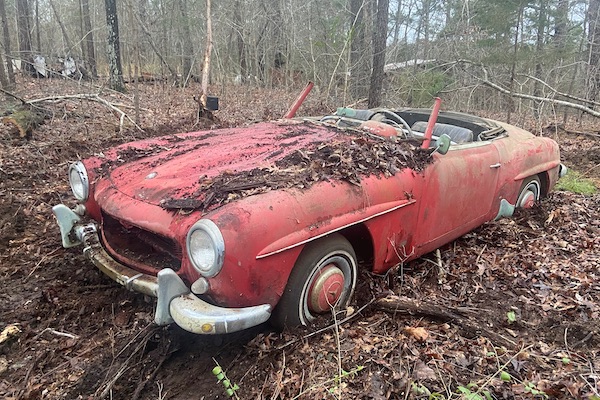
What we’ve learned to distinguish carefully is the difference between surface corrosion and structural compromise. Surface rust in visible locations can look alarming on a sixty-year-old European car while leaving the structure underneath fundamentally sound. The more consequential scenario is structural deterioration that has been addressed cosmetically — fresh paint or undercoating applied over compromised metal rather than properly repaired metal. In our experience, a car with solid, honest, verifiable structure — even with visible surface patina — presents more credibly to serious buyers than one with a fresh cosmetic presentation over an uncertain substrate. Documentation of structural restoration, when it’s been done, is an asset that pays for itself in buyer confidence.
The twin Solex 44 PHH carburetors that define the M121’s character have taught us something consistent across every W121 we’ve acquired: the difference between a 190SL that drives as it should and one that doesn’t is, more often than not, a carburetor problem rather than an engine problem. Accelerator pump diaphragms wear. Jets clog. Synchronization drifts across decades of use and storage. A 1963 190SL with carburetors that have been properly rebuilt and synchronized by someone who knows them drives entirely differently than one that hasn’t, and that driving difference is immediately apparent to buyers who have experience with the platform. We’ve seen carburetor service transform how a car presents more dramatically than almost any other single corrective measure available on a W121.
Engine and gearbox condition tell us what the car’s mechanical history has been, and we’ve found that honest accounts of both are consistently preferable to surprises discovered during assessment. A drivetrain with documented recent work — rebuild receipts, service records, a clear account of what was done — tells a story we can work with. Acknowledged deferred maintenance is manageable and factors into the assessment accordingly. What creates problems isn’t a car that needs work; it’s a car whose condition diverges materially from what was represented.
Modifications on a 1963 190SL carry additional weight relative to mid-production cars, because the buyers seeking final-year examples tend to care more deeply about factory specification than driver-quality buyers do. A five-speed conversion with the original gearbox retained, documented, and present alongside the car is a different situation than one where the original unit is permanently gone. Sympathetic, reversible mechanical improvements with original components preserved and documented typically cost little in collectibility with the right buyer. Irreversible departures from factory specification — incorrect engine transplants, modified bodywork, non-original interior configurations — narrow the buyer pool more sharply on a 1963 car than they would on a mid-production example, and we factor that honestly rather than otherwise.
Soft top condition, interior specification, and overall presentation factor into the assessment proportionally. They’re real variables and meaningful signals about how a car has been maintained, but secondary to structure and mechanicals in determining what a 1963 190SL actually is and what it’s worth to the buyers who want one.
Ready When You Are
Send us clear photographs of the car as it is — exterior from all angles in good light, interior, engine bay, trunk, undercarriage if accessible, any areas of structural concern, the hardtop if present. The chassis number from the firewall. Whatever documentation you have. A brief account of the car’s situation and history.
We’ll respond within 24–48 hours with either a specific offer and the reasoning behind it, or a direct explanation of why we’re not making one. If an offer is made and agreed to, payment wires and logistics follow on your schedule. Five to seven days from agreement to completion in most circumstances. This is the final-year car! It deserves a buyer who understands that. Reach out when you’re ready.
Ready to Sell Your 1963 Mercedes-Benz 190SL?
Send photos and basic information about your car to [email protected] or call us directly at 310-975-0272. We’ll respond within 24–48 hours.
Mercedes-Benz 190SL Series
- Selling Your Mercedes-Benz 190SL
- Selling Your 1955 Mercedes-Benz 190SL
- Selling Your 1956 Mercedes-Benz 190SL
- Selling Your 1957 Mercedes-Benz 190SL
- Selling Your 1958 Mercedes-Benz 190SL
- Selling Your 1959 Mercedes-Benz 190SL
- Selling Your 1960 Mercedes-Benz 190SL
- Selling Your 1961 Mercedes-Benz 190SL
- Selling Your 1962 Mercedes-Benz 190SL
Why Choose Beverly Hills Car Club?
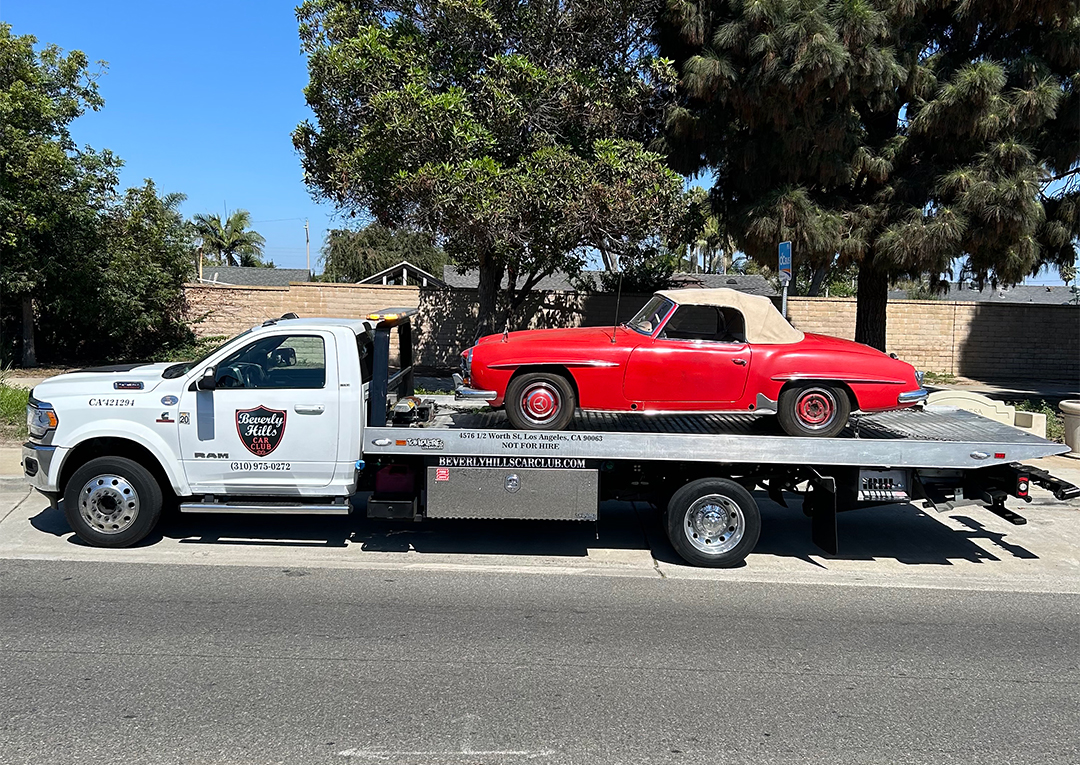
Beverly Hills Car Club has been a trusted name in classic car buying since 2004. We offer fair market valuations, immediate payment, and free nationwide pickup. Whether your 1963 190SL is a pristine matching-numbers final-year survivor, a driver-quality roadster, or a project awaiting completion, we have the expertise to assess it accurately and make a genuine offer. No hidden fees, no manufactured delays — just a clean, professional transaction on your timeline.
Rocco F.
1979 Mercedes 450SEL 6.9
March 28, 2026
“Entire process very easy, low pressure and fair. With one phone call the deal was completed to everyone’s satisfaction.”
Suzan S.
1972 Mercedes 450SL
March 17, 2026
“I want to thank all the various people that assisted me every step of the way in selling both of my vehicles. All of you have been very helpful and supportive and answering all my questions. I was assisted by Valarie Van Dam, Tina Morales and a gentleman name of Robert. You were all very personable and the customer service was great. Thanks to all of you for everything.”
Kevin B.
1966 Mercedes 230SL
March 12, 2026
“I sold Alex my 1966 Mercedes-Benz 230 SL, a car I’ve have had for almost 30 years. The transaction and negotiation were smooth, and money was wired the next day after we agreed on price. Alex was very reachable and promptly got back to me. If I another car or a friend who had an antique car I would strongly recommend him contacting Alex.”
Abigale L.
1977 Mercedes-Benz 300D
March 11, 2026
“He was super nice and clear with everything. I’ll definitely be calling y’all again in the future.”
Dennis M.
1964 Mercedes 230SL
March 7, 2026
“Alex and his team were incredible to work with. The sale price was agreed upon quickly and reasonably, funds were transferred in a timely basis, and Camille and Corrine made the paperwork and transportation process a breeze. Very happy with the overall experience.”
Mitchell F.
1959 Mercedes 190SL
March 4, 2026
“Selling my classic car went smoothly and working with Alex and his team was great!!”
Lois Z.
1964 Mercedes-Benz 230SL
February 28, 2026
“The entire transaction went smoothly and professionally.I would highly recommend Alex Manos.”
Ben M.
1971 Mercedes-Benz 280SL
February 23, 2026
“This was my first experience with Alex, but I can tell you it wont be my last. He was so polite and professional to work with. From the beginning to the end everything went super smooth. He is a man of his word. He and his team kept me up to date along the entire process. The 1971 280SL was picked up in a timely manner and went super smooth. I am super happy with everything.”
Baron C.
1987 Mercedes-Benz 560SL
February 8, 2026
“Overall Experience was 5 Star.”

Next Steps?
Call Now
Or email via our website and we’ll go over all you need to know to sell your classic!
Send Photos
Just send a few photos, this is often all we need to make an offer!
Get Paid!
We pay via wire transfer promptly upon agreement. Fast and easy!

Get Started!
Welcome!
join our inventory newsletter
Sign-up for our e-mail alerts
join our newsletter
Sign-up for our e-mail alerts
Learn More
or
we buy classic cars
Looking to sell yours?
Contact us
Sell us your car
Pick up from any USA location - Any condition - Top $$$ Paid


Chat With Us!